Happy April! Spring is a hopeful time of year in Vermont – may this season of renewal bring a bit of joy to you, despite so much heartache around the world.
Tax Time. April is also tax time, with April 15th the deadline for filing your state and federal income tax returns fast approaching. While most federal tax changes made last summer largely benefit wealthy Americans and big corporations, we made changes to state tax laws last year that will benefit moderate income Vermonters, seniors, families with young children, veterans, and military retirees. 2025 Act 71, which was my bill, expanded Vermont’s list of tax credits and exemptions. Read this excellent summary of Act 71 for more details.
You can find a complete list of Vermont’s tax credits and more information about filing your personal income taxes on the Department of Taxes website. Many tax credits are refundable, which means that if you qualify for one, even if you don’t owe taxes, you should file your income tax return to receive a check from the state. Check out this website, Anti-Poverty Tax Credits for a Strong Vermont, for more information about how such tax credits could help you if you are struggling financially. Finally, the United Way has a free online tax filing assistance tool which may be helpful – My Free Taxes – so check it out!
Land Use & Housing. Recently, the Senate advanced a bill to spur more housing development and slow down the land use reform provisions included in 2024 Act 181, which was itself a major overhaul of Vermont’s land use law, known as Act 250. Our work got a lot of attention, so I’m going to try to answer some questions and give you some links to where you can learn more.
Two years ago, the Legislature passed Act 181, with the goal of loosening the requirements of Act 250 to make it easier to build housing across Vermont. Act 181 created a new process and structure for planning the future land use of Vermont. Act 181 defined three land use tiers: Tier 1 in cities and towns where most development would occur; Tier 3 where environmentally sensitive areas would be protected; and Tier 2 with everything else, including sparsely populated rural areas, farmland, and forestland. Act 181 also included a land use planning process that begins with municipal town plans and maps, then moves up to regional planning commission plans and regional maps, and finally a statewide land use plan and map approved by the Land Use Review Board.
Finally, Act 181 created a series of “interim housing exemptions” that were meant to spur housing development by exempting many housing projects from a lengthy Act 250 development review. These housing exemptions have been really successful at jump-starting much needed housing development in communities across the state. However, other parts of Act 181, namely the so-called “road rule” that will trigger Act 250 development review for roads longer than 800 feet, and some parts of the preliminary Tier 3 maps have caused quite a few concerns. To address these concerns and give the overall process more time for community engagement, the Senate passed S.325 which extends the housing exemptions, improves the planning & mapping process, loosens the requirements for Tier 3 & the road rule, and delays their effective dates until mid-2028 and early-2030 respectively.
S.325 passed in the Senate Natural Resources Committee on a bipartisan, unanimous vote and all of the testimony we received was supportive of the bill. After it passed, a vocal group gathered at the State House to protest the bill and Act 181 in general. This spurred a partisan split on the Senate floor for many votes, although the final vote on S.325 was a unanimous voice vote. I support S.325 and giving the process more time and flexibility. I know there are many legitimate concerns about how some elements of Act 181 could impact private land and personal development plans. S.325 is now in the House Environment Committee, so there is still time for more changes to the bill. The Senate Natural Resources will also begin work on H.932 about forestry regulation under Act 250, so there will be more opportunities for changes there too. I have been talking with many constituents, so if you have questions, concerns, or ideas about these bills, please reach out to me and other committee members, so we can better understand your perspective.
There’s a lot of misinformation out there, much of it driven by political groups trying to create a wedge issue, so for accurate information about Act 181, you can read the LURB’s website on Act 181: Modernizing Land Use Review. You can also check out the Addison County Regional Planning Commission’s website about Building the Future of Addison County or the Addison County draft Regional Plan. You can also look up land parcels on the draft Future Land Use Map, You can also contact your town’s planning commission, or better yet, join your town’s planning commission, as many towns are in the process of updating their town plans as part of this overall work. There’s still time to learn more, provide input, be involved, and make changes to the process, maps, and rules that apply!
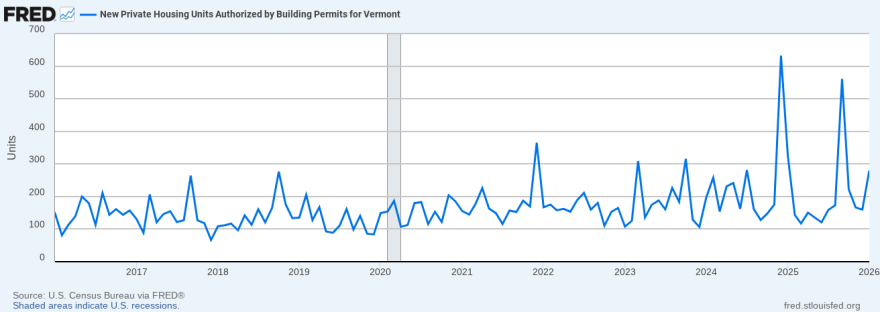
Photo Note: The header photo shows a graph of housing permits authorized over the past decade. The large spikes for 2024 and 2025 show the increase in housing development since the passage of Act 181.
Discover more from Ruth for Vermont
Subscribe to get the latest posts sent to your email.
