Protecting Vermonters’ financial security was a priority this legislative session, especially because many people are struggling to make ends meet as our national economy falters. Across key areas, we passed legislation that will help Vermonters save money and protect their personal finances. As a member of the Senate Finance Committee, I worked on each of these bills. Some of these bills impact all Vermonters, some are targeted at specific groups, like students, farmers, foster youth, or seniors, but all of them aim to save Vermonters money and protect your financial security. Read below for summaries of how these bills could help you or your loved ones be more financially secure.
#1. H.949 Lowers Property Taxes & Increases Renter Credit. We know property taxes have strained personal budgets for many Vermonters, so in developing this year’s annual “yield bill” which sets the property tax rate for the coming year, we prioritized ensuring a modest average statewide education property tax rate increase of 3.5%, spending $100 million of one-time funds to “buy down” the rate significantly. Similarly, at my urging, we implemented a one-time $4 million increase to the Vermont renter credit so that renters would also save money. We also expanded eligibility and amounts for the property tax credit, meaning more Vermonters will qualify for tax credits to lower their property tax bills. Finally, H.949 limits school budget and public & private school tuition increases over the next several years. For more information, see the Education Fund Outlook and JFO fiscal note for the bill.
#2. H.385/Act 106 Protects Against Financial Exploitation & Coerced Debt. With financial scams on the rise, you likely know someone who has been a victim of financial exploitation. Act 106 allows banks to put a temporary hold on certain money transfers if they suspect a person may be the victim of a scam or fraud. The bank can then work with the person, and potentially a designated family member or friend, to prevent financial exploitation. Act 106 also protects survivors of domestic abuse or human trafficking and vulnerable adults who are survivors of abuse, neglect, or exploitation who incur debt due to an abuser’s threatening or fraudulent behavior. The bill establishes a process to report and investigate these instances of coerced debt and provides remedies under the Vermont Consumer Protection Act. For more information about how to protect yourself & loved ones from financial scams, check out the VT Attorney General’s website about scams and the National Bank of Middlebury’s website about Senior-Targeted Fraud.
#3. S.190 Reduces Hospital & Insurance Rates. Last year, we directed the Green Mountain Care Board to implement what’s called reference-based pricing, a tool used to lower hospital prices, the biggest driver of high health care costs in Vermont. S.190 speeds up this implementation with a focus on qualified health benefit plans and health benefit plans for school employees, one of the biggest cost drivers for school budgets. While this bill has the potential to reduce both health care and education costs, most Republicans voted against it, so it’s uncertain if the Governor will sign it. Read this excellent op-ed for more information and reach out to the Governor’s office and ask him to sign the bill.
#4 H.577 Creates Discount Prescription Drug Program. H.577 creates the Vermont Prescription Drug Discount Card Program open to all Vermont residents to pool prescription drug purchasing power with other US states, territories, and non-governmental organizations. The program will be run by the VT Treasurer’s Office and enable Vermonters to sign up for an ArrayRx Card that they can use for a discount when filling a prescription, directly saving Vermonters money.
#5. H.648 Protects Investments & Savings. H.648 updates and strengthens regulations for banking, insurance, & securities investments, ensuring Vermonters’ money is better protected. Importantly, H.648 bans cryptocurrency kiosks in Vermont, following a sharp increase in cyberscams last year, including those involving cryptocurrency which is “now a major mechanism of cybercrime in Vermont,” These kiosks are difficult to regulate and monitor, making them easy sites for fraud & scams, and many states are prohibiting their use. H.648 also provides greater protections for businesses against exploitative merchant cash advances, which are usually loans that exact a percentage of sales revenues as part of repayment.
#6. H.657 Saves Social Security Benefits for Foster Youth. Currently, the Department of Children & Families (DCF) collects and spends federal supplemental security income (SSI) benefits paid to foster youth as a means to pay for their state care, preventing youth from exiting foster care with any savings or personal financial stability. H.657 prohibits DCF from using these personal SSI benefits to offset the cost of foster care and requires DCF to establish a VT-ABLE savings account for each child in their care who receives SSI benefits. Such a fund will help foster children pay for any unmet needs and allow them to save for future needs beyond foster care. The bill also eliminates driver’s license & other vital records fees for unaccompanied youth. See the JFO fiscal note for more information about all of the provisions in H.657.
#7. H.933 Expands Home Down-Payment Assistance. The annual miscellaneous tax bill modifies Vermont tax law to offset the negative impact of Trump’s federal tax changes last year in H.R.1. The bill also extends the tax credits that fund the Down Payment Assistance Program that helps qualified homebuyers afford a mortgage. H.933 also expands Vermont’s Research and Development Tax Credit to be the most generous in the country, helping Vermont businesses of all sizes invest in research & development to grow and improve their business. See the JFO fiscal note for further information on all of the provisions in this bill.
#8. H.635 Eliminates Corrections Supervisory Fees. For many years, the Department of Corrections has charged a monthly supervisory fee to anyone on probation, furlough, supervised community sentence, or parole. These fees are difficult to collect and put financial pressure on Vermonters who may already be struggling to get back on their feet. H.635 eliminates these fees starting in 2027 and forgives the significant backlog of outstanding fees, which both eases the financial burden on vulnerable Vermonters and eliminates the cost of collecting these fees.
#9. H.512/Act 109 Limits Event Ticket Resale Prices. Act 109 establishes a price cap on the resale of event tickets. This cap protects customers from exploitation by scalpers or ticket resale companies, and protects entertainment & sports venues from ticket speculation where ticket resale companies pose as official box offices and sell tickets they don’t possess, steering business away from real local venues. Artists and local entertainment venues supported the bill as a means to protect the financial security & integrity of local arts & entertainment venues.
#10. S.323 Eliminates Farm Operation Fees. To help support struggling farmers, S.323 eliminates the annual fees paid by medium and large farm operations to the VT Agency of Agriculture. Trump’s tariffs, cuts to agriculture support, and his war with Iran driving up fuel & fertilizer costs have made already difficult finances even more dire for many Vermont farmers, so every little bit helps them stay afloat.
#11 S.202 Permits Low-Cost, Portable Solar. S.202 creates a framework for Vermonters to purchase small, low-cost solar panels that can be easily plugged in for use on balconies, porches, and patios, making these portable, renewable energy devices accessible to renters, people with modest incomes or small homes, and highly-mobile young Vermonters. These devices will lead to lower electric bills, making them a financially-beneficial renewable energy option.
#12 H.951 Expands Student Scholarships. H.951 raises the family income eligibility threshold for the Freedom & Unity Scholarship from $65,000 to $80,000, meaning more students will qualify for scholarships to make college feasible. H.951 is the big FY27 state budget which includes many other provisions to help Vermonters, including funding for food & health care assistance, housing supports, and appropriations to fund important government programs.
You can read more about these and other bills in this article about key bills in Seven Days. I will also be providing more details about bills passed this session over the next few weeks. Reach out if you have questions. More information coming soon!
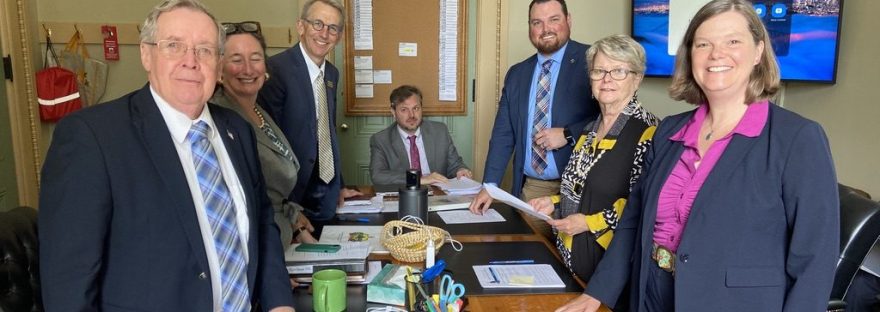
Photo note: Members of the H.933 Miscellaneous Tax Bill conference committee, and our trusted attorney, after we reached an agreement.
Discover more from Ruth for Vermont
Subscribe to get the latest posts sent to your email.
