It’s May and flowers are blooming – daffodils, tulips, violets, dandelions, magnolias, azaleas, and more are bursting at my house! I hope you are enjoying the beauty of Spring in Vermont.
May also usually means the end of the legislative session is in sight. We’re making progress on finalizing bills, but Governor Scott has threatened to shutdown state government if we don’t pass an education bill that forces school districts to consolidate, something that is unpopular with both legislators and most Vermonters. I am doing my best to work with colleagues to produce an education bill that moves forward with responsible education reform without harming students, the public school system, and local communities. The next few weeks will be action-packed, to be sure. Below is an update, for now.
Money Bills. This past week, the Senate passed its version of a $9.37 billion state budget, which in dollar amounts and specific appropriations is very close to the budgets proposed by the Governor and passed by the House. You can find highlights of the Senate budget here. With federal COVID and flood relief funding all but spent, and other federal funding for health care, human services, resilient infrastructure & renewable energy cut or clawed back by Trump & the Republican Congress, this is the tightest state budget Vermont’s seen in years. Many budget requests will go unfunded.
Overall, though, I believe the Senate budget strikes a decent balance during a year when many Vermonters are struggling. However, two items are very concerning to me. First, the Senate budget includes a provision that would take $12 million from the State Higher Education Trust Fund that provides college scholarships to Vermonters to fund a stalled $100+ million sports facility at UVM. Raiding a fund that helps hundreds of Vermont students attend UVM, CCV, or the state colleges to build a fancy sports complex is inconceivable to me, especially during a time when many Vermont families are struggling to make ends meet. I could not have afforded college without the help of scholarships and neither could my own children. This is true for so many young Vermonters – we should be expanding college scholarships, not taking the money for frivolous building projects. I made this argument on the Senate floor and tried to amend the budget to remove this provision, but was unfortunately unsuccessful.
Second, the Senate budget fails to adequately fund the State Ethics Commission. The Commission provides guidance and oversight to state and local public officials and enforces the State Ethics Code, but it has suspended much of its work due to lack of funding. I have long been a supporter of the Ethics Commission and transparent & ethical government. Vermont trails most other states in its oversight of ethics complaints; in an era when trust in the government is low, we must ensure we’re supporting appropriate ethics oversight for public officials. The House budget did not take scholarship money for the UVM sports complex and did provide a modest increase in funding for the Ethics Commission, thus I’m hopeful that the House budget negotiators will prevail on these points in their talks with the Senate.
Last week the Senate passed H.933 the Miscellaneous Tax Bill that among other things, updates Vermont tax law in response to H.R.1, the federal tax bill passed by the Republican Congress last year that greatly reduced taxes on large corporations. As such, H.933 adjusts Vermont corporate taxes to prevent many of these corporate tax breaks from flowing through to Vermont and further hampering the state budget. H.933 also invests in the business research & development tax credit and the downtown & village tax credit to spur economic development and support businesses located in Vermont. The bill also shifts some revenue to the struggling Transportation Fund which has been losing funding as more fuel efficient cars generate less gas tax revenue. You can read the Joint Fiscal Office (JFO) summary of H.933 here.
The Senate also passed the annual “yield bill,” H.949 which sets the amount of revenue necessary to fund school district budgets passed by local voters on Town Meeting Day. The Senate allocated approximately $101 million of reserve funds to “buy down” property tax rates across the state to an average increase of 3.8%. It’s important to note that this is a statewide average, so most towns and taxpayers will see varying increases, depending on school budgets, property values, and incomes. The Senate version of H.949 includes a one-time $4.0 million increase in the renter credit, which I proposed to ensure that renters can access a similar benefit from this one-time buy-down of property tax rates. You can read the JFO summary of H.949 here. Both H.933 and H.949, like the budget bill, will now likely go to a conference committee with the House.
Natural Resources Bills. Last fall, the new Commissioner of Fish and Wildlife issued new guidance for the process and timing of posting land from hunting and fishing, creating concern and confusion for town clerks, landowners, and Vermonters who hunt or fish. While the Commissioner rescinded his guidance after overwhelming push back, a slew of bills were introduced to clarify the law and respond to concerns. The Vermont Constitution provides Vermonters with the right to hunt and fish on most lands, except those that are “inclosed,” which for decades has meant posted with signs prohibiting hunting or fishing and recorded annually with the town clerk.
The Senate Natural Resources Committee, where I serve, heard from many Vermonters who wanted us to make it easier to post their land & protect their property and also from Vermonters who wanted to make sure we didn’t interfere with their right to hunt on lands in the state. We tried to strike a balance by passing H.723 that clarifies the timing but maintains the requirement to post land each year and ensures that “accidental or unintentional deviations” from land posting requirements do not negate land postings as long as it’s clear to “reasonable” people that the land is posted and steps are taken to correct any posting errors. The Governor signed the bill into law last week, so there is now clarity for town clerks, landowners, and hunters & anglers.
The Natural Resources Committee continues work on a bill to update Vermont’s Bottle Bill (H.915) and a bill to ensure strong regulations of any data centers proposed in Vermont (H.727). We also look forward to getting S.325 back from the House, which will update Act 181 to repeal Tier 3 and the “Road Rule.” I am supportive of the House’s in-depth work on these issues and support both of these repeals. I’ll have further updates on all of these bills after we’re finished with our work. Finally, if you’re interested in how the Agency of Natural Resources (ANR) manages state lands, they are working on new rules and inviting public comments on the ANR Public Lands Management Planning Rule. Several public hearings are scheduled and public comments are welcome before June 18th.
Finally, as a book-lover, I’m excited for a few upcoming events: May 15 is the Bixby Library Annual Gala in Vergennes. May 20 is Middlebury’s Sheldon Museum’s event Drawing on the Archive: Tillie Walden’s Charity & Sylvia, celebrating a new graphic novel by Vermont’s Cartoon Laureate, Tillie Walden, that tells the story of one of America’s earliest documented same-sex couples who lived in Weybridge in the early 19th century. Tillie’s book is the Vermont Humanities Council 2026 Vermont Reads book choice with related events all year.
Plus, on June 3 save the date for my Vermont Senate Re-Election Campaign Kickoff with Hannah Sessions at American Flatbread. More details coming soon! Thank you for reading and take care.
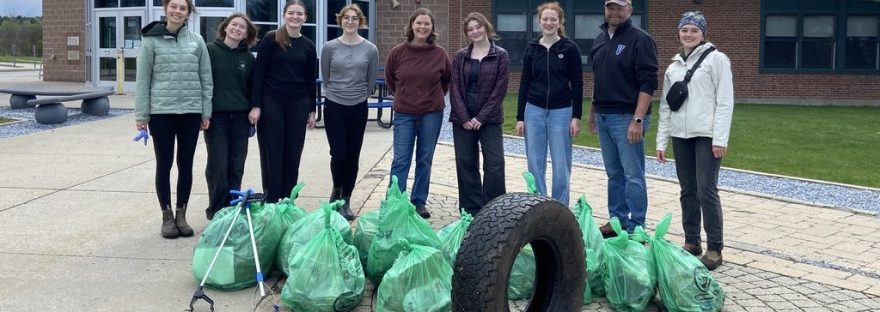
Photo Note: Green Up Day on May 2nd with the Vergennes Union High School Green Team!
Discover more from Ruth for Vermont
Subscribe to get the latest posts sent to your email.
