The Legislature adjourned last week after passing major legislation to advance the transformation of our PK-12 education system. In January, the Governor threatened to shutdown state government and keep the legislature in session all summer if we didn’t pass legislation that forced school districts to merge into a small number of mega-districts. After weeks of negotiations, where I played a key role, we reached a compromise between the Governor, House, and Senate leaders that creates a voluntary locally-directed, but tightly scheduled, process for merging school districts.
You might recall that last year, although I helped improve the initial education transformation legislation, Act 73, I wasn’t able to support it in the end due to major concerns about content and process. This year, I strategically worked to prevent a similar outcome, communicating regularly with education leaders and colleagues in both houses of the legislature to advocate for a bill that would follow many of the recommendations of the School Redistricting Task Force and move forward with the tax and finance reforms in Act 73. I kept the Senate Democrats together and most Republicans followed when the Governor signed off on the deal I helped negotiate; only two senators and 10 representatives voted against the compromise. Below is an outline of the major provisions of the bill, H.955.
Cooperative Education Service Areas (CESAs). The bill creates seven CESAs, including one already established in southeast Vermont, to provide regional services to school district, including special education, business, IT, professional development, and transportation, with the goal of creating economies of scale, lower costs, and more uniform quality for these shared services. The CESAs are formed around existing school district boundaries, with most of the schools in the Addison Senate District assigned to the Champlain Valley South CESA. CESAs are common in many other states, including most rural states, and provide significant cost-savings and more comprehensive services than a single school district can do on its own.
Merger Committees & Process. H.955 creates 21 merger committee groups to analyze and propose potential school district mergers. The committees, made up of school board members from local school districts, will be kept on track by facilitators hired by CESAs and are required to start their work this fall. The groups are organized around existing school district relationships, with the main Addison County school districts (ACSD, ANWSD, Mount Abe & Lincoln) together; Huntington with MMUUSD & CVSD; Orwell, Whiting, Leicester & Goshen with northern Rutland; and Granville-Hancock & Rochester with WRVSU. Districts can ask to join another merger group, but all districts must participate in these discussions in good faith, with local communities deciding how to make it all work.
The process for recommending mergers is largely based on existing law and will be familiar to local communities that merged under Act 46 about a decade ago. As part of negotiations with the Governor, however, we agreed to a fairly aggressive timeline for the merger process – merger committees will form in October 2026; their merger recommendations are due September 2027; final State Board of Education approvals are by December 2027; local votes on merger proposals will be March 2028; and new school districts will become operational July 2029. Given the level of attention to this issue and the expertise in the field, I am optimistic that communities are ready to make this process work. Mergers are not required, but the financial and programmatic realities in small school districts with declining enrollment mean that merging with neighbors is likely the right choice for many school districts in Vermont.
School Construction Program. Act 73 reestablished, but didn’t fund, a state school construction program that’s been dormant since the 2008 financial crisis. H.955 provides staffing & further details for the program, which will not start until new school districts come online in 2029. Importantly, H.955 also identifies funding sources for school constructions needs, which is desperately needed for Vermont’s crumbling school buildings. State aid for new and legacy construction debt will be tied to whether districts merge, plan to expand student offerings, and are addressing building health & safety needs. Local funding for school construction will be allowed on top of the regular foundation formula amount, and will generally require voter approval. Vermont’s school buildings are the 2nd oldest in the nation, with major structural, programmatic, and health concerns; some larger districts will also need to accommodate more students in existing buildings, so facility renovations and new school construction are desperately needed for education reform to work.
Foundation Funding Formula. Act 73 created a new foundation formula to fund schools that will go into effect, replacing our current tax capacity funding formula, in July 2029 after school district mergers. Act 73 commissioned a professional study to provide further data to ensure an analytically sound funding formula to include funding for special education, pre-kindergarten, career & technical education, secondary education, and geographic cost differences. This report will be completed in December 2026, so H.955 includes contingencies requiring the Legislature to enact updates to the foundation formula to account for this new information before it goes into effect. We want to be sure that Vermont’s funding formula provides the amount of funding necessary to provide an excellent education to all Vermont students, while also ensuring a predictable, stable budget for schools and tax rate for Vermonters.
Career & Technical Education (CTE). H.955 ensures that CTE is integrated into CESA services, merger committee discussions, the foundation formula, regional high schools & new school districts, and school construction plans. It’s clear that CTE cannot take a backseat as we transform our education system, so H.955 reiterates the importance of CTE.
Education Tax Reform. H.955 advances the tax changes enacted in Act 73, better defining property classifications to accurately create a “second home tax.” This tax, which won’t go into effect until new school districts are established in 2029, will help moderate property taxes for average Vermonters. The bill also advances the formation regional assessment districts meant to maintain a more uniform property appraisal system in Vermont. These tax changes, plus a new income sensitive property tax exemption, go hand-in-hand with the new school districts and funding formula, and should result in more stable and predictable tax rates.
As my friend and colleague, House Education Chair Peter Conlon, said, “We’ve given school districts across Vermont a huge homework assignment.” School leaders and community members must now take on the task of analyzing and planning for school district mergers. While mergers are not required, many will be necessary for schools to be financially viable moving forward. There will be people who push back on mergers & education reform to protect the structure and options they currently have, but it’s crucial that everyone come to the table with an open mind and the willingness to make tough decisions to strengthen our public education system for all communities. Declining enrollment, crumbling infrastructure, and increasing student needs & educational costs demand action.
If policy makers in Montpelier can come together across party lines, branches of government, and differing priorities, local leaders can do the same. I know our communities are up for the task. H.955 moves education reform forward by respecting local democratic decision-making, addressing real education cost drivers, and ensuring equitable tax changes are implemented. I am proud of the role I played in crafting this major legislation and I stand ready to help.
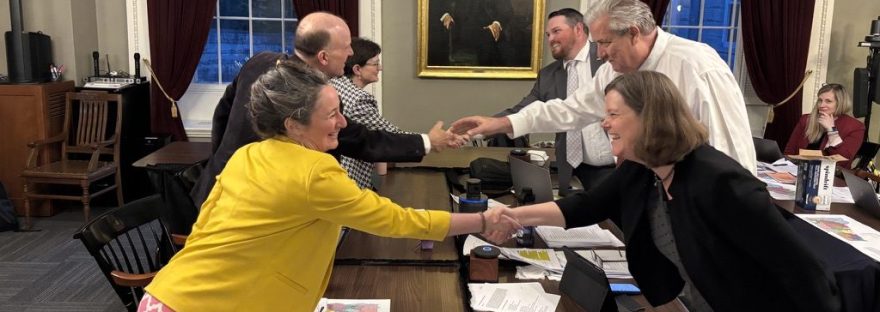
Photo Note: The House and Senate H.955 Conference Committee members shaking on our bi-partisan agreement for the final bill package.
Discover more from Ruth for Vermont
Subscribe to get the latest posts sent to your email.

3 thoughts on “Consensus K-12 Education Reform”
Comments are closed.